
National Education Policy(NEP)

ABOUT
National Education Policy 2020 is the first education policy of the 21st century and aims to address the many growing developmental imperatives of our country. This Policy proposes the revision and revamping of all aspects of the education structure, including its regulation and governance, to create a new system that is aligned with the aspirational goals of 21st century education, including SDG4, while building upon India’s traditions and value systems.
In the 81st year of encouraging innovation in education, the KES’ Shroff College recognizes the necessity of an inclusive approach for a qualitative as well as quantitative magnification in the Indian education system.
If you are looking forward to take admission in undergraduate programmes at KES’ Shroff College, Mumbai, you are recommended to go through the Government of Maharashtra – GR dated 20th April 2023 for clarity on the various rules and regulations as recommended by the state department of Higher and Technical Education.
THE VISION OF NEP2020
- An education system rooted in Indian ethos that contributes directly to transforming India, that is Bharat, sustainably into an equitable and vibrant knowledge society, by providing high-quality education to all, and thereby making India a global knowledge superpower.
- The curriculum and pedagogy of our institutions must develop a deep sense of respect towards the fundamental duties and Constitutional values, bonding with one’s country, and a conscious awareness of one’s roles and responsibilities in a changing world.
- To instil a deep-rooted pride in being Indian, not only in thought, but also in spirit, intellect, and deeds, as well as to develop knowledge, skills, values, and dispositions that support responsible commitment to human rights, sustainable development and living, and global well-being, thereby reflecting a truly global citizen.
Implementation of NEP at KES’ Shroff College
KES’ Shroff College has been at the forefront for holistic education of students. Some of the key aspects of NEP2020 such as Multilingualism, inclusion, Diverse subject combinations, emotional and spiritual wellbeing of students are already introduced in the academic structure after becoming autonomous. NEP2020 provides us an opportunity to create a more inclusive, flexible, and relevant education system.
Undergraduate Education at KES’ Shroff College, under the aegis of NEP2020
KES’ Shroff College , as an institution, a culture, and a community, has carved out an impressive position for itself in the field of education in India. Through a determined effort to create an environment that fosters the holistic development of its students, KES’ Shroff College aims to be a space for the celebration of creativity, the rediscovery of tradition, and the encouragement of innovation.
With these objectives our college has developed a new structure as per the directives from the Maharashtra State – Department of Higher and Technical Education.
The framework of the choice-based credit system
- Major Subject: A single subject course of study pursued by a student as a mandatory requirement of the programme of study.
- Elective Course: An elective course could be a project designed to acquire skills to supplement the major study.
- Minor Subject: A second subject of study pursued by a student as an additional requirement of the programme of study.
- OE: Open Elective – An elective course chosen generally from an unrelated discipline/subject, to seek multidisciplinary exposure.
- AEC: Ability Enhancement Course – Mandatory Courses on content related to Language, and Literature (i) Compulsory – English communication (ii) Elective – any Indian language other than English.
- VSC: Vocational Skill Course – Courses aimed at imparting practical skills, hands-on training, and soft skills to increase the employability of students. Specific or supporting the major subject is to be chosen from a basket/pool offered by the college.
- SEC: Skill Enhancement Course – Courses aimed at imparting practical skills, hands-on training, and soft skills to increase students’ employability. It could be chosen from a basket/pool offered by the college or a MOOC on Swayam or NPTEL platforms.
- On-Job Training(OJT)/Internship/Field Project (FP)/ Research Project (RP): Application of knowledge/concepts in solving or analysing a real-life problem. All these are related to the major subject.
- CC: Co-curricular Course – For the holistic development of students through Cultural activities such as performing art, visual art, NCC, NSS, Yoga, etc.
- VEC: Value Education Course – Compulsory courses on:
(i) The Constitution of India and
(ii) Environmental Education.
Committee Members
- Dr. Samrat Srivastava, Chairperson
- Dr. Kishor Mahajan, Member
- Ms. Priyanka Radhakrishnan, Member
- Ms. Vidhi Doshi, Member
- Ms. Amita Singh, Member
- Ms. Vianna Pillai, Member
- Mr. Mahesh Gagh, Member

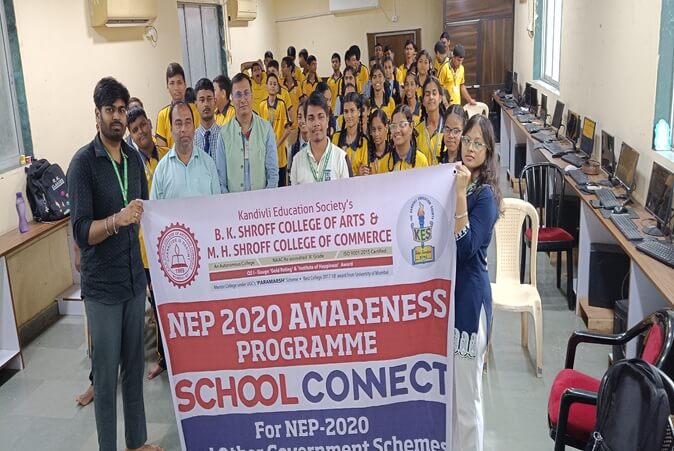

- To ensure equitable, inclusive, and quality education accessible to all sections of society.
- To promote holistic, multidisciplinary, and skill-based learning that nurtures creativity and innovation.
- To integrate technology and digital literacy for preparing learners for the 21st-century knowledge economy.
- To strengthen foundational literacy and numeracy as essential pillars of lifelong learning.
- To foster ethical, cultural, and environmental awareness for responsible citizenship and sustainable living.
- To revitalize Indian languages, arts, and knowledge systems within modern education frameworks.
- To empower teachers through continuous professional development and innovative pedagogy.
- To encourage research, innovation, and entrepreneurship through academic freedom and institutional support.
- To align education with employability, vocational skills, and industry needs for national development.
- To position India as a global knowledge leader rooted in its civilizational values and committed to human welfare.
- It will nurture holistic growth and intellectual development among learners.
- Help youth to become responsible, ethical, and globally aware citizens of the nation.
- It will prepare young minds to emerge as visionary leaders and innovators of the future.
- Promote integration of ethical, value-based, and experiential learning in all educational institutions.
- Strengthen emotional intelligence, resilience, and inner discipline for balanced personal development.
- Encourage appreciation and preservation of India’s diverse cultural heritage and knowledge systems.
- Foster national pride, cultural rootedness, and respect for constitutional values.
- Inspire students to practice empathy, compassion, and universal human values in everyday life.
- Equip learners with critical thinking, creativity, and adaptability to face modern global challenges.
- Contribute to building a peaceful, inclusive, and sustainable society guided by wisdom and integrity.